

The most interesting skincare traditions are less about chasing a perfect complexion, as if an AI filter is hovering over their face, and more about simple, health-conscious habits built into everyday life. Across cultures, many enduring practices rest on simpler ideas: a cleansing ritual, an oil massage, a trip to the sauna, or a simple pharmacy staple.
These practices reflect different ideas about what healthy skin care should look like. They’re worth exploring with curiosity, but also with restraint. Some are surprisingly practical, while others are better appreciated as cultural traditions than copied wholesale.
The Japanese Double-Cleanse
Japanese double cleansing has become a global skincare staple, but its appeal is surprisingly practical. The routine uses an oil-based cleanser first, then a water-based cleanser, with each step serving a different purpose.
Shiseido, a leading Japanese beauty brand, describes the first cleanse as the step that breaks down surface-level makeup, grime, and other impurities. You massage an emulsifying cleansing oil into the skin, then rinse it away.
The second cleanse uses a water-based formula, such as a gel or cream, to clean away what remains after the first step. Shiseido recommends choosing the second cleanser according to your skin type and rinsing it thoroughly before continuing with the rest of your routine.
The useful idea isn’t simply to wash twice. It’s understanding that thorough cleansing doesn’t have to mean aggressive cleansing. That’s a principle worth carrying into any routine, especially when winter weather already dries out your skin.
Korean Skinimalism
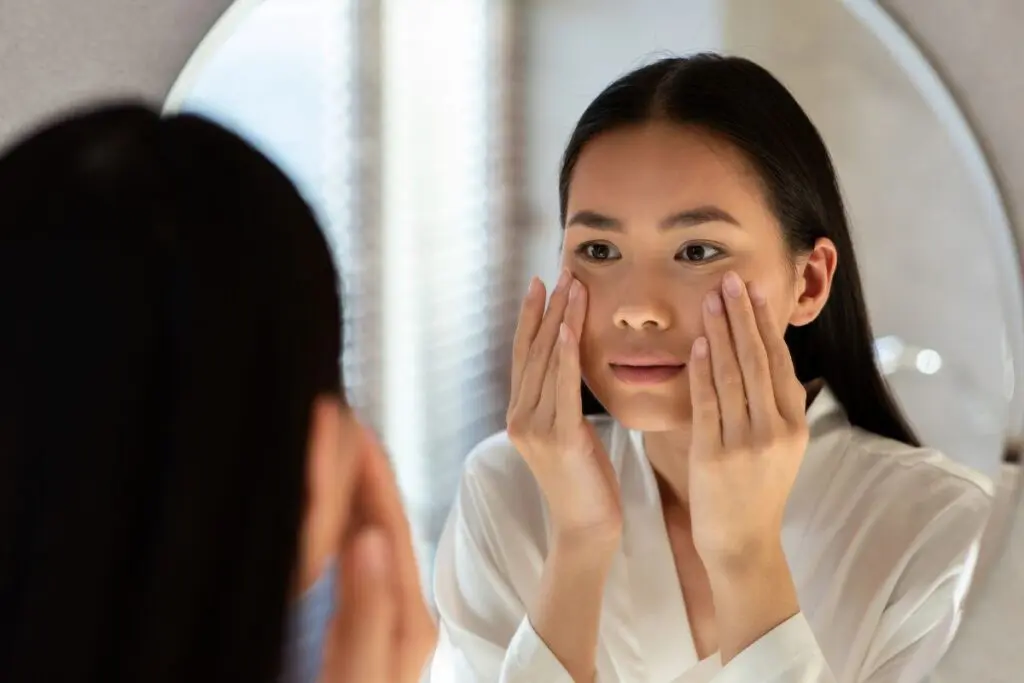
Korean skincare became famous in the West for elaborate routines, but the more interesting development is the move toward skinimalism and skip-care. The idea is almost a correction to K-beauty’s reputation: use fewer products, choose them deliberately, and don’t layer something onto your face just because it’s trending.
That doesn’t mean Korean skincare has abandoned experimentation. K-beauty remained a major global force last year, with the conversation increasingly balancing elaborate routines with more streamlined approaches.
There’s a useful lesson here: a 10-step routine isn’t automatically more thoughtful than a three-step one. The best routine is the one where every step earns its place.
Ayurvedic Abhyanga
Abhyanga, an Indian practice of warm-oil self-massage, has deeper roots than the modern wellness industry’s love affair with body oils. Classical Ayurvedic texts, including the Charaka Samhita and Sushruta Samhita, describe oil massage as part of dinacharya, or a daily routine.
Traditionally, the practice is about much more than applying oil to the skin. The massage itself is the ritual: warm the oil, slow down, work it deliberately over the body, and make ordinary self-care feel worth the time and effort.
That may be the most transferable part. You don’t need to adopt every element of an Ayurvedic routine to borrow its underlying idea. Care can be a practice, not another task to rush through.
French Pharmacy Staples
French pharmacy skincare has a very different personality from the maximalist beauty counter. Thermal spring waters, simple moisturizers, micellar waters, and straightforward formulations have become closely associated with the French pharmacy tradition.
The culture is still evolving, but the minimalist instinct remains recognizable. Escentual describes French pharmacy skincare as no-nonsense, with longtime staples like Embryolisse Lait-Crème Concentré and Bioderma Sensibio H2O alongside newer formulas.
The simplicity is less about a bare-bones routine for its own sake and more about giving each product a clear job: cleanse without complicating the process, moisturize when the skin needs it, and avoid adding steps simply because they are fashionable.
That restraint is particularly useful in winter, when it can be tempting to keep adding products in response to dryness. The French pharmacy philosophy offers a quieter alternative: build a small routine around dependable basics, then let it become a ritual.

The Nordic Sauna + Cold Rinse
In Nordic countries, sauna culture turns temperature itself into part of the ritual. In Finland, the tradition goes back thousands of years, evolving from early earth-pit saunas into the wood-heated and electric saunas found throughout the country today. The sauna was traditionally a practical place for cleansing and warmth, but also became an important setting for relaxation and social connection.
The ritual is about more than sitting in a hot room. Finnish sauna culture centers on löyly, the steam created when water is thrown onto heated stones, and traditionally includes periods of cooling down before returning to the heat. Finnish sauna culture is recognized by UNESCO as an Intangible Cultural Heritage of Humanity, reflecting how deeply the practice is woven into everyday life.
You don’t need to recreate an extreme temperature routine to borrow the idea. A sauna session followed by a comfortable cool-down can become a deliberate transition between heat and recovery. Later, learning about cold exposure can also add context to a practice long part of Nordic wellness traditions.
Not Every Viral Ritual Is Worth Stealing
This is where some skepticism helps. Cultural traditions can offer useful ideas, but the internet often strips practices from their context and turns them into the week’s must-have beauty hack. That makes DIY self-care essentials a useful counterpoint: simple, purposeful care can be more valuable than constantly adding something new.
Snail mucin is a good example. It isn’t necessarily useless; research suggests it can be moisturizing and protective, but social media and beauty marketing have also amplified its popularity. A University of Colorado School of Medicine review found that viral skincare ingredients, including snail mucin, do not always align with expert recommendations.
The same applies to whatever ingredient suddenly dominates TikTok, Instagram or a beauty retailer’s homepage. A ritual doesn’t become better because it is exotic, expensive or difficult to pronounce. If the appeal disappears when you remove the marketing hype, it’s probably not a tradition worth stealing.
Supporting Skin From Within
External care is only one part of the broader picture. Nutrition provides the building blocks the body uses for normal physiological processes, so a nourishing diet is a key foundation for overall wellness and healthy skin.
For people who want targeted nutritional support, CHOQ’s Female Vitality STAQ fits alongside everyday habits and is positioned to support healthy skin from within. The supplement should complement a balanced lifestyle, not turn skincare into another complicated checklist.
Keep the Ritual, Lose the Hype
The most useful skincare traditions aren’t valuable because they come from somewhere else. They’re valuable because they remind us that caring for our skin doesn’t have to mean constantly buying something new.
A careful cleanse, a warm oil massage, a simpler product shelf, time in the sauna, or a few quiet minutes spent caring for yourself can all become meaningful rituals, and ultimately part of your long-term wellness routine. The real luxury may be consistency: doing a few sensible things well enough, and long enough, for them to simply become part of your life.